
Instagram’s New Terms and Whether Meta Now Owns Your Photos
Instagram’s New Terms and Whether Meta Now Owns Your Photos
Meta's new terms don't take ownership of your Instagram photos. See what changes November 20 and January 20, who it covers, and how to protect your work.
- 1Does Meta Own Your Photos Under Instagram’s New Terms?
- 2What Changes in Meta’s Commercial Terms on November 20?
- 3What Changes in Instagram’s Terms of Use on January 20, 2027?
- Do Instagram’s New Terms Apply to a Personal Account?
- 4Are the New Instagram Rules Part of the New Terms?
- 5Is Meta Using Your Instagram Photos to Train AI?
- How Do You Stop Meta From Using Your Instagram Photos for AI?
- 6Should You Switch Instagram to a Personal Account Over the New Terms?
- Does Making Instagram Private Protect Your Photos?
- Does Deleting Instagram Remove Your Photos From Meta?
- 7Can Meta Crawl the Website Linked to Your Instagram?
- How Do You Block Meta’s Crawlers With robots.txt?
- 8Quick Takeaways
The Short Answer: Meta does not own your Instagram photos, and neither of Meta’s two terms updates changes that. Instagram’s Terms of Use still say “We do not claim ownership of your content,” today and in the version that starts January 20, 2027. What changes is narrower: from November 20 Meta may crawl websites tied to business use, and from January 20, 2027 a Professional profile, meaning a creator or business account, counts as business use.
Instagram’s new terms have set off a rumor that, from October 30, every photo on a business account belongs to Meta. One r/Instagram poster asked exactly that on October 23 and said they had just switched to a personal, private account.
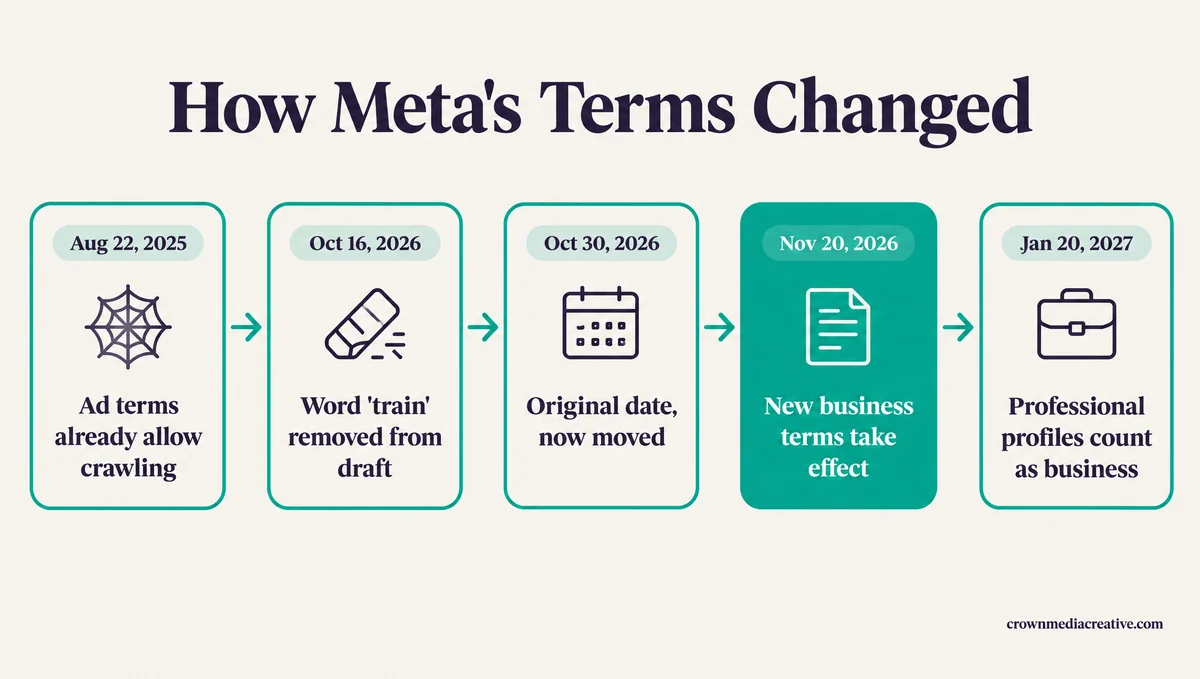
The rumor runs on an old date and gets the ownership wrong. Meta moved its business terms to November 20, and the ownership wording has not changed in either update. The license to “create derivative works” that people keep quoting has sat in Instagram’s terms since at least May 2018.
My advice is to hold off on deleting anything until you know which of the two changes reaches your account. Below are both changes in Meta’s own words, the settings that keep your photos away from Meta’s AI, and the two lines that ask its main crawlers to stay off your website.
Does Meta Own Your Photos Under Instagram’s New Terms?
Meta does not own your photos under Instagram’s new terms, and you keep the copyright. Section 4.3 of Instagram’s Terms of Use says “We do not claim ownership of your content,” and the version that starts January 20, 2027 keeps that sentence word for word.
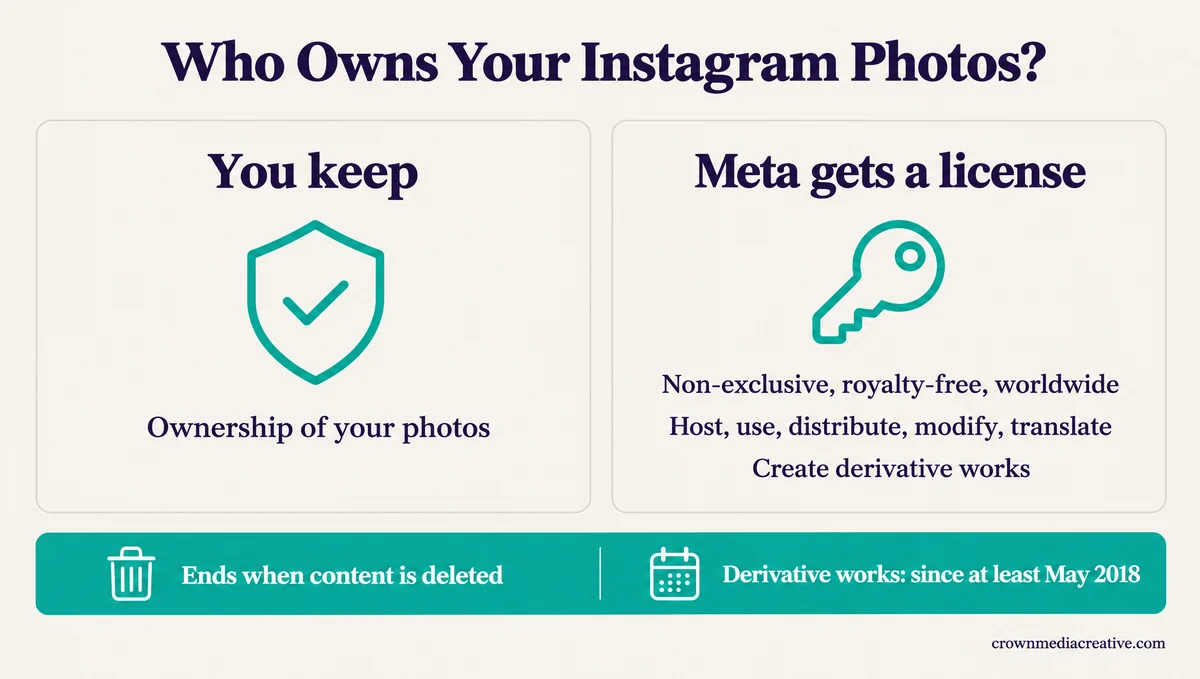
What you give Meta is a license, and it is a wide one. The same section grants Meta a “non-exclusive, royalty-free, transferable, sub-licensable, worldwide license to host, use, distribute, modify, run, copy, publicly perform or display, translate, and create derivative works of your content.” It adds that this use stays “consistent with your privacy and application settings.”
In plain words, Meta can store, show, resize, translate and edit versions of your photo to run Instagram, and it can pass that permission on to others. “Non-exclusive” means you can still sell or license the same photo to anyone, and the license ends “when your content is deleted from our systems.”
The derivative works line gets quoted the most, and I find it the least worrying part, because it is old. A May 2018 archived copy of Instagram’s terms already grants a license to “create derivative works of your content.” The older terms, saved in January 2018, granted a “license to use the Content” with no mention of derivative works.
Instagram has been through this exact panic before. In December 2012, users read a terms update as permission to sell their photos, and Instagram rolled back the advertising section to its 2010 wording. Kevin Systrom, then Instagram’s chief executive, said “it is not our intention to sell your photos.”
What Changes in Meta’s Commercial Terms on November 20?
Meta’s Commercial Terms and Self-serve Ad Terms change on November 20, 2026, three weeks after the October 30 date Meta first gave. The update widens what counts as business use, adds “create derivative works” to the rights you promise Meta, and lets Meta crawl websites tied to that use.
What are the Meta Commercial Terms: The extra contract that applies when you use Facebook or Instagram for business, on top of each app’s normal terms of use.
Meta’s Business Help Center notice dates the updated Commercial Terms and Self-serve Ad Terms to November 20, 2026. The October 30 date is still everywhere partly because Meta never finished changing it. On October 26, the preview of the new terms carried a banner saying the updates “will come into effect on 20 November 2026.”
The footer of that same preview still read “Effective date: 30 October 2026.” That mix-up is Meta’s own doing, and it bugs me, because so much of the panic runs on the old date.
Who the terms cover barely moved, though the list of business activities grew. The current version, in force since March 6, 2024, already applied to business use “regardless of the entity type,” so individuals using Meta for business were covered before this update. The preview adds marketing messages, listing products, product catalogues and “any business product, such as Ads Manager or Meta Business Suite,” and it now names the Instagram Terms of Use.
The license paragraph gains two lines. You now promise you hold the rights to let Meta “display, distribute, create derivative works and deliver your Content,” and Meta may use that content “to provide, develop, improve, research and maintain” its products. The derivative works wording is new to these terms, though Instagram’s own terms have carried it since at least May 2018.
The first draft went further. Digiday reported that Meta “removed the word ‘train’ from the terms on Oct. 16” amid complaints from publishers. The website-crawling clause they objected to is still in the preview.
Advertisers who use Meta’s AI tools get one more rule. The new terms warn that “AI features may make mistakes” and say you must not “alter or remove any watermark or content-authenticating metadata generated by AI.”
The bigger change for creators comes two months later, in Instagram’s own terms.
What Changes in Instagram’s Terms of Use on January 20, 2027?
Instagram’s Terms of Use change on January 20, 2027, when running an Instagram Professional profile starts to count as business use under the Meta Commercial Terms. Ownership and the photo license stay the same, though a new example lets Meta show your content in connection with ads.
Instagram’s Terms of Use page now opens with a notice: “We’re updating our Terms of Use. These updates go into effect on January 20, 2027.” The preview of the new version keeps the ownership section and the full license list, and many of its edits swap the word “account” for “profile.”
One new sentence, in the section on extra terms, answers whether a creator account counts as a business. It lists “buying ads, selling products, developing apps, operating an Instagram Professional profile, or using our measurement services” as business use and says that use “will be subject to the Meta Commercial Terms.”
So for creators, the answer is yes. The November terms define business use by what you do and which tools you use. The January terms add the account type itself, so a creator or business profile falls under the Commercial Terms even without ads.
Four other additions follow, and the first two deserve a careful read:
- The permission that lets Meta show your username and likes next to ads “without any compensation to you” gains a new example: Meta may “display your content in connection with ads or commercial experiences.” In plain words, from January 20, 2027 your posts can appear alongside ads, and you are not paid for it.
- “You are responsible for the actions of anyone you authorize to use your profile or account,” which covers an agency, an assistant or an app you gave your password to.
- Anyone collecting data from Instagram in an automated way must follow Meta’s “Automated Data Collection Terms.”
- Meta may remove content that breaks “applicable self-regulatory advertising codes.”
Do Instagram’s New Terms Apply to a Personal Account?
Instagram’s new terms change little for a personal account you post on for fun. The business rules turn on what you do, such as ads, selling or business tools, and, from January 20, 2027, on whether you run a Professional profile.
| Your account | Meta’s November 20 business terms | Instagram’s January 20, 2027 terms |
|---|---|---|
| Personal account, posting for yourself | Not business use | Ordinary Terms of Use only |
| Personal account used to sell things | Covered, since selling counts “regardless of the entity type” | Covered, selling products is named |
| Creator or business profile with no ads | Covered when you use business tools such as Meta Business Suite or a product catalogue | Covered, a Professional profile counts as business use |
| Running ads or boosting posts | Covered | Covered, buying ads is named |
If you post for yourself on a personal account, I don’t think either update changes much for you beyond the ads example above. If your profile is how you make money on Instagram, assume both sets of terms apply to you.
Are the New Instagram Rules Part of the New Terms?
The new Instagram rules people pass around, like the five-hashtag cap and the 13+ teen setting, are product and policy changes. Neither appears in Meta’s November business terms or in Instagram’s January preview.
Instagram capped posts and reels at five hashtags in December 2025, a change our hashtag guide walks through. Teen accounts moved to a 13+ content setting based on movie ratings in October 2025.
Instagram’s rule on accounts that mostly repost is the same kind of change. “If most of what you post to Instagram is someone else’s content, your account is no longer going to be recommendable,” Instagram head Adam Mosseri said in April 2026, as PetaPixel reported.
I keep these rule changes apart from the terms, and you should too, because lumping them together only feeds the panic.
Is Meta Using Your Instagram Photos to Train AI?
Meta uses public Instagram posts, photos included, to train its AI, and has said so since 2023. That permission comes from Meta’s privacy policy, which neither new set of terms rewrites, and Meta says private posts are not used.
Meta said in a September 2023 post that publicly shared Instagram and Facebook posts, “including photos and text,” were part of its generative AI training data. The same post says “We didn’t train these models using people’s private posts.”
The reach goes back years. At an Australian Senate inquiry in September 2024, Meta’s global privacy director Melinda Claybaugh agreed that public posts and photos back to 2007 had been scraped, including children’s photos on parents’ public accounts. Australians, unlike Europeans, had no way to opt out.
The crawl clause in the new Commercial Terms names its purpose as developing, improving and researching “advertising and business products.” To me, “develop” is still wide enough to cover AI work, and nothing in the clause rules training out.
Either way, Meta’s training on public posts rests on its privacy policy, which Meta updates over time, and that same policy covers what Instagram collects about you.
The closest call came in July. When Meta launched Muse Image on July 7, 2026, every adult public profile was opted in as a reference anyone could @-mention to make AI images. Meta pulled that feature from Instagram three days later, saying it “missed the mark.”
How Do You Stop Meta From Using Your Instagram Photos for AI?
Making your account private is the strongest step, because Meta says it does not train on private posts. After that, switch off content reuse, file Meta’s objection form if you live in the EU or UK, and keep photos out of Meta AI chats.
Public is the trigger, so start there. Here is the order I would go in:
- Go private if your audience allows it. Private profiles were also left out of Muse Image.
- Switch off reuse. Go to your profile, tap the three lines and open Sharing and reuse. Turn off posts and reels under “Allow people to use your content on Instagram with AI features on Meta,” the label TechCrunch listed in July. That toggle governs other people reusing your posts with AI features, and its label says nothing about Meta’s own training.
- File the objection form if you live in the EU or the UK; Meta sent its link through in-app notifications. Meta extended the form to UK users in September 2024, and TechCrunch reported in April 2025 that Meta will honor EU objection forms “it has already received, as well as newly submitted ones.”
- Keep private photos out of Meta AI chats. Meta’s 2023 post makes an exception for messages when “you or someone in the chat chooses to share those messages with our AIs.”
What will not work is a copy-and-paste post saying you do not give Meta permission. The terms you accepted are the contract, and a status update cannot rewrite them.
Should You Switch Instagram to a Personal Account Over the New Terms?
Switching Instagram to a personal account removes only the Professional-profile trigger that starts January 20, 2027. It does not change who owns your photos, the license every account grants, or Meta’s AI use of public posts.
My view is that switching to personal is the weakest of the three moves people reach for. It costs you insights and promotion tools, and selling or running ads still counts as business use whatever your account type.
| Move | What it changes | What it does not change |
|---|---|---|
| Switch to a personal account | Removes the Professional-profile trigger from January 20, 2027 | Ownership, the license, AI use of public posts, or selling and ads counting as business use |
| Make the account private | Takes your posts out of the public pool Meta trains on and out of reuse features | Training that already used your posts while they were public |
| Delete the account | Ends the license once your content leaves Meta’s systems | Copies other people reused, and AI models already trained |
Does Making Instagram Private Protect Your Photos?
Making Instagram private is the setting that keeps your photos out of Meta’s public-post AI training from then on, since Meta says it does not train on private posts. It cannot pull back anything already used while the account was public.
The poster who switched to personal and private picked the right half of the move, because going private is the part that protects the photos. The license itself remains, since Meta still hosts your posts, but Meta’s use must stay “consistent with your privacy and application settings,” so they show only to followers you approve. The cost is reach, because strangers can no longer find your posts.
Does Deleting Instagram Remove Your Photos From Meta?
Deleting Instagram ends Meta’s license only once your content is deleted from Meta’s systems, a process the terms say starts within 30 days of your request. Copies other people reused under the license stay covered until they delete them.
One r/Instagram poster wanted to delete their Meta account “so meta would never steal any of my art.” Deletion does end the license for that art, but only from the point it leaves Meta’s systems.
Instagram’s terms say the deletion process “will automatically begin no more than 30 days after your request,” and that it “may take up to 90 days to delete content after the deletion process begins.” Content others used under the license, and have not deleted, stays covered “until that content is deleted.” Nothing in the terms promises to pull your photos back out of AI models already trained.
If you delete single posts instead, they wait in Recently Deleted for 30 days first, which our guide to deleted posts explains. Deleting is the last move on my list. If you do leave, spend a few weeks first with your bio pointing at an email sign-up page you own, so your audience can follow you out.
Can Meta Crawl the Website Linked to Your Instagram?
Meta can crawl a website linked to your Instagram from November 20 if that site is tied to business use, under a new clause in the Commercial Terms. The only brake Meta offers is robots.txt, and the terms never mention it.
What is robots.txt: A small text file at the root of a website that tells named crawlers which pages they may visit. Following it is voluntary.
The new clause lets Meta “use automated software (such as web scrapers, bots, robots, spiders, crawlers and user agents) and create test credentials.” Those can crawl “the domains, web pages or URLs” tied to your products or services and “periodically pull updates” from them.
Test credentials are logins, so the clause reads as letting Meta create its own accounts to get past a sign-up page. That line worries me more than the crawling itself, since free members-only pages, such as a resource library or a community forum, often sit behind exactly that kind of login.
For advertisers, website crawling is not new. The current ad terms, in force since August 22, 2025, already say that placing an ad order grants Meta the right to crawl your domains for “research and training.” The new version drops “training” but moves a wider clause into the Commercial Terms, which cover every kind of business use.
Meta’s answer to critics is robots.txt. On October 23 it told Reuters that “content owners will still be able to use robots.txt to signal preferences.” In the same report, Senator Marsha Blackburn said “American creators and small businesses are not a free source of content for Meta to exploit.”
How Do You Block Meta’s Crawlers With robots.txt?
Blocking Meta’s crawlers takes two robots.txt entries, one for meta-externalagent and one for meta-externalads. Meta’s own documentation says two of its other crawlers may skip robots.txt, so the file narrows the door without shutting it.
Meta’s crawler documentation, updated May 21, 2026, says meta-externalagent crawls “for use cases such as training foundation AI models.” It says meta-externalads crawls for “improving advertising and other business-related products and services,” the work the new clause describes.
Add these lines to the robots.txt file at the root of your site:
User-agent: meta-externalagent
Disallow: /

User-agent: meta-externalads
Disallow: /
I leave facebookexternalhit alone on any site I run, because it builds the preview card when someone shares your link. Meta also says that crawler “might bypass robots.txt” during security checks, and meta-externalfetcher “may bypass robots.txt rules” because it fetches pages a person asks for.
Expect a delay, since Meta says crawlers may cache robots.txt “for up to 24 hours.” If you run ads that send people to the site, think twice before adding the meta-externalads line, because that crawler serves Meta’s ad products.
This only works on a site where you control the root folder. On a hosted link-in-bio page you usually cannot edit robots.txt at all, so that choice sits with the host. If you have no site of your own, the crawl clause has little of yours to reach, so put your effort into the privacy settings above.
Quick Takeaways
- Meta does not own your Instagram photos, and the “create derivative works” license has been in Instagram’s terms since at least May 2018.
- From November 20, Meta’s business terms let its crawlers read websites tied to business use, so add the meta-externalagent line to your robots.txt, plus the meta-externalads line unless ads send people to your site.
- From January 20, 2027, a Professional profile counts as business use, and Meta may show your posts alongside ads without paying you, whatever your account type.
- If your audience allows it, make the account private, since that keeps your posts out of Meta’s public-post AI training from then on.
- Meta has already moved the date and cut the word “train” once, so check the final wording on November 20 before you switch account types or delete anything.

