
Why TikTok Sends You Back to 300 Views After Going Viral
Why TikTok Sends You Back to 300 Views After Going Viral
A viral post buys you nothing on the next upload. Why TikTok scores every video from scratch, which mistakes deepen the drop, and the checklist for climbing back
- 1TikTok Doesn’t Care About Your Last Post
- 2Is 300 Views on TikTok Good or Bad?
- 3Consistency Is the Only Real Strategy
- 4Viral Posts Usually Have One Strong Element
- 5Common Mistakes That Kill Your Reach
- a. Faceless content without connection
- b. Repeating old formats
- c. Weak captions and bad categorization
- 6The Shadow Ban Myth
- 7One Distribution Limit That Has Nothing to Do With Your Hook
- 8How to Build Long-Term Growth on TikTok
- 9Quick Fix Checklist for Low Views
- 10Frequently Asked Questions
- Is 300 views a lot on TikTok?
- How do you get out of 300 view jail?
- Why do my views drop right after a video goes viral?
- Does deleting and reposting the video reset your reach?
- Can TikTok settings cap your views instead of your content?
- How long does the post-viral drop last?
You post something on TikTok. It takes off, maybe 85,000 views, maybe 900,000. Comments pour in. Followers spike. You think, “This is it.” You expect the next one to ride the wave.
Instead, your next video gets 312 views. Or worse, it stalls at 180. You refresh. Nothing changes. Just like that, you’re back in what creators call “300-view jail.”
That’s TikTok working exactly as designed.
Many creators experience this. They go viral once, maybe even multiple times, but can’t seem to recreate it at will. The algorithm rewards content, not creators. Your viral video didn’t boost your account. It boosted that one post, and the algorithm moved on.
This article breaks down:
-
Why TikTok resets your reach after each post
-
What you can do to improve consistency
-
Tips from real creators who’ve been through it
The short answer: a viral video does not lift your account’s baseline, so your next upload re-enters the same small test audience that every post starts in. Creators consistently report that batch topping out near 300 views, which is why the number looks identical across so many accounts.
TikTok has never published the size of that initial test audience, so treat 300 as an observed pattern rather than a setting. What genuinely changes after a hit is who is watching: a viral post pulls in a broad, loosely matched crowd, and the next video is measured against people who followed for one clip rather than for you.
TikTok Doesn’t Care About Your Last Post
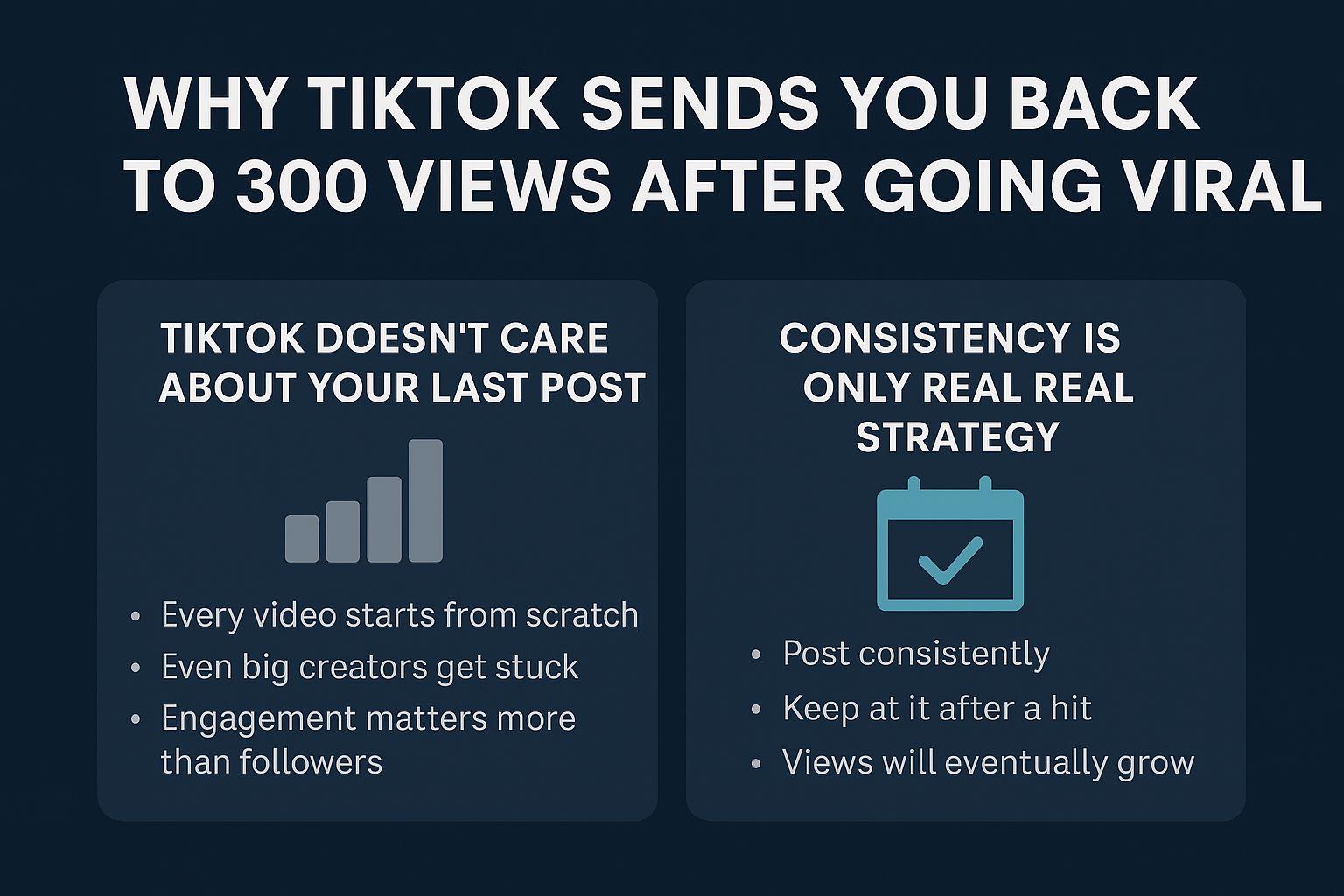
A common misconception is that going viral once will unlock permanent reach. It won’t. TikTok judges each post on its own performance, regardless of your follower count or past success.
Here’s how it works:
-
Every video starts from scratch
TikTok shows your video to a small group. If it performs well, it expands to more viewers. If it doesn’t, that’s the end of the line. -
Even big creators get stuck
Accounts with millions of followers see the same thing. One video does 6 million. The next gets 400 views. That’s normal. -
Engagement matters more than followers
TikTok prioritizes watch time, replays, comments, and shares. Not who posted it. You can have 100 followers and outperform someone with 1 million.
One commenter nailed it: “Their algorithm shifted to evaluating each and every post. If that post isn’t performing they’re not going to push it. Try again with the next one.”
Going viral means nothing for your next video. TikTok is a slot machine, and you’re pulling the handle again with every upload.
Is 300 Views on TikTok Good or Bad?
Three hundred views is neither on its own. It is where a video lands when it finishes its first round of distribution without earning a second one. That makes it a stalled test, and it says nothing about your account overall.
The number only means something in context. If 300 is where your videos start before climbing over a day or two, distribution is working normally. Videos that stop there every time are failing the first round.
TikTok publishes no benchmark for a healthy view count and no target for creators to hit, so any specific figure quoted as the standard is somebody’s guess. Watch whether watch time and completion rate move between uploads instead, because those are the signals that decide whether a video leaves the test batch at all.
Consistency Is the Only Real Strategy
While going viral feels random, building steady growth isn’t. Multiple creators in the thread pointed to a long-term approach: consistent, quality content over time.
Here’s the pattern:
-
You post consistently
-
One video goes viral
-
You get a small wave of followers
-
Views drop back down
-
You keep posting
-
Another one hits
-
The cycle repeats
-
Eventually, your baseline views grow
Slow, but it repeats.
One user said:
“Keep staying consistent and another one goes viral. Another little flood of followers. Keep at this and you trickle your way up… until the viral videos start happening more and more often.”
This isn’t just guesswork. TikTok’s own Creator Academy recommends the same thing, posting consistently, testing formats, and analyzing what performs best.
Quality still matters. So does niche. But the backbone of TikTok growth is showing up, over and over again, even when the views drop.
Viral Posts Usually Have One Strong Element
If you’ve gone viral before, it wasn’t by accident. Look closer, and you’ll usually find a strong, standout element that pulled people in, something the algorithm latched onto.
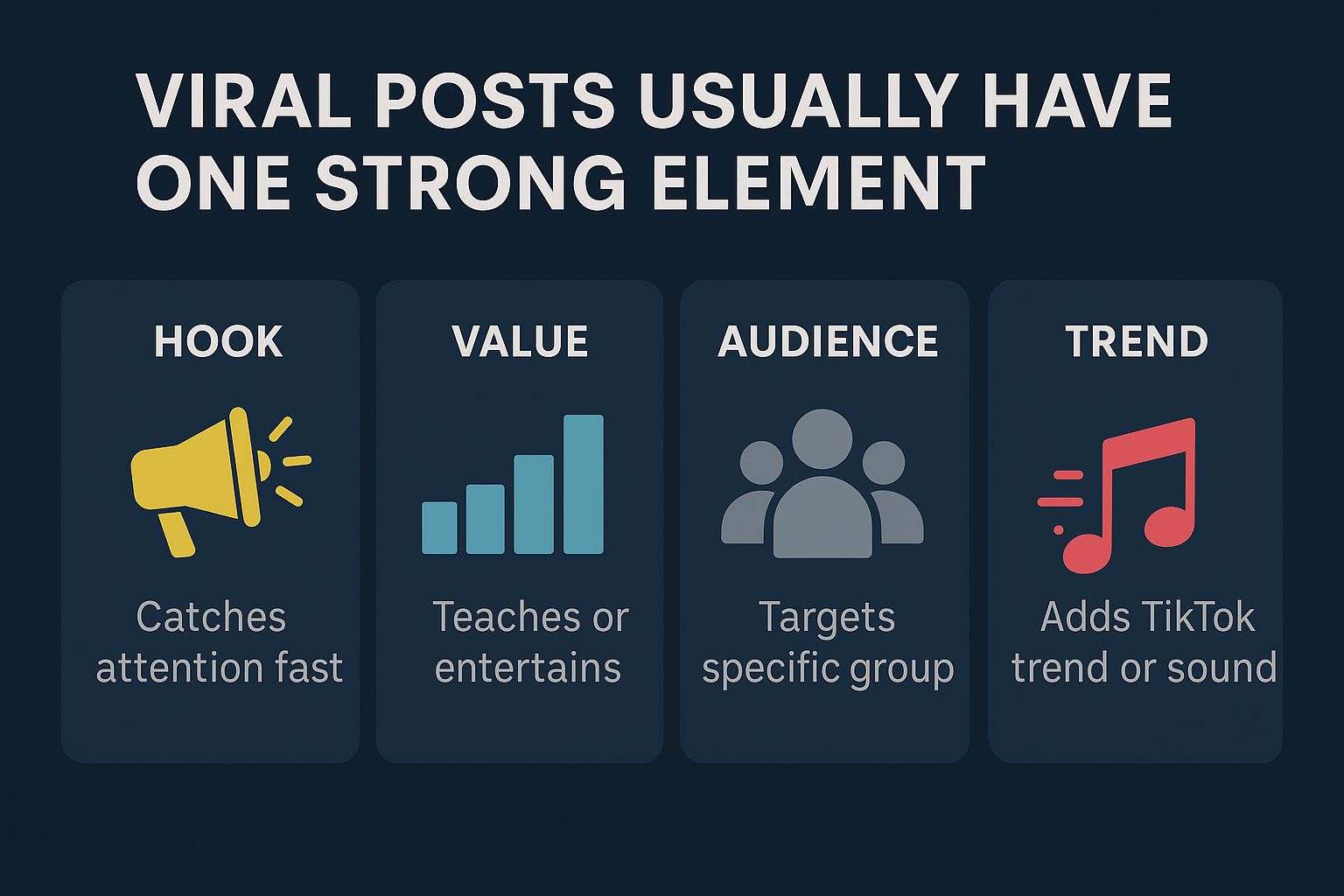
Here’s what commenters identified as common viral triggers:
-
A visually striking first frame
One user highlighted a video that opened with bright, colorful dessert shots. Another said the best-performing clip started with a flashy chocolate dish in Dubai. -
A viral sound or trend
“The sound I used was viral, and I jumped early on the trend.” TikTok is trend-driven. Using a trending audio early gives your post more chances to get picked up. -
A clear visual hook
Start with the final product instead of a buildup. That “payoff” early on improves watch time.
Ask yourself:
-
Would this thumbnail stop someone scrolling?
-
Is my first second strong enough to hold interest?
-
Did I tap into a sound or trend that’s already gaining traction?
If not, rework it. One small change can be the difference between 300 views and 85K.
Common Mistakes That Kill Your Reach
Plenty of good creators still struggle because of avoidable mistakes. Here are a few patterns users identified in the thread, and what to watch for:
a. Faceless content without connection
One commenter said, “Your content is simple, but it wouldn’t make me want to follow you.” There’s no face, no story, no reason to click follow.
But this isn’t always a dealbreaker.
Another user replied: “Some of my favorite accounts are faceless.” The key is making up for that lack of presence with editing, story flow, or style.
b. Repeating old formats
TikTok moves fast. A pacing style that worked last month might be stale today.
Advice from the thread:
“Start with the brightest, most indulgent shot. Re-edit old ones with that in mind.”
How you start matters as much as what you shoot.
c. Weak captions and bad categorization
One user warned against vague, non-descriptive captions.
Better:
-
Use keywords that match your niche
-
Think: would this still make sense if the video were deleted?
TikTok is search-based now. Help it help you.
The Shadow Ban Myth
Many creators think their videos are being “punished” after going viral.
Truth is:
-
TikTok doesn’t shadow ban creators who go viral
-
The drop in views is part of the natural cycle
-
The reset puts you back at square one, with no targeting involved
As one creator said:
“No, this literally always happens. If my video goes viral, the next one gets 300 views.”
That said, avoid:
-
Copyrighted sounds
-
Spammy links or comments
-
Community guideline violations
-
Overly promotional content
There is a documented reach restriction, and it is not a shadow ban. TikTok’s For You feed standards make some posts ineligible for the feed while leaving them on your profile, and the wording is conditional: content is ineligible “if it includes unoriginal or reused material without anything new”.
Reusing a clip is not itself disqualifying, and adding something of your own to it is what keeps a post eligible. Ineligibility is also never announced, which is exactly why people reach for the shadow ban explanation.
Otherwise, keep creating.
One Distribution Limit That Has Nothing to Do With Your Hook
If the video that stalled promoted a brand, a gifted product or an affiliate link, there is a compliance question underneath it that has nothing to do with your opening second. This only applies to that kind of post, so most organic uploads can skip ahead.
TikTok’s Branded Content Policy was published on 4 August 2026 and takes effect on 31 August 2026. The four categories it covers carry over unchanged from the April 2026 version, so these rules already apply today. Branded Content covers content that features or references:
- A product or service that has been gifted to you by (or on behalf of) a brand
- A brand, product or service that you have been paid to post about, whether in money or in gifts
- A product or service for which you will receive a commission on any sales, for instance via an affiliate link or promotional code
- A brand that you have or have had a commercial relationship with, such as acting as a brand ambassador
The requirement itself is stated plainly: “When posting Branded Content, you must enable the commercial content disclosure toggle.” Turning it on labels the post automatically, and where the law requires it, the post may be added to the TikTok Commercial Content Library.
Two lines in the policy bear on reach. For promoted categories subject to market-specific requirements, TikTok says it “may prevent the content from being accessed in the relevant countries, or apply other restrictions”. Where the rules are not followed, it “may remove the content or impose other restrictions”.
TikTok has never published a view number tied to the disclosure toggle, and no line in the policy connects it to a 300-view floor. What the policy does establish is that disclosure sits outside content quality as its own compliance question, and that it already covers ordinary affiliate and gifted-product posting.
Open your content disclosure settings before you blame the edit. A post missing a disclosure it needed is worth sorting out either way.
How to Build Long-Term Growth on TikTok
Want to beat the system? Build a process you can repeat every week.
Try this:
-
Post at least 3 to 5 times per week
-
Stick to one clear content lane
-
Hook people in the first second
-
Use tools like Flick to optimize captions
-
Engage with replies
-
Stay current with trends
-
Test new formats monthly
Need better region targeting or safe multi-account management? Use clean proxies like The Social Proxy to reduce risk and avoid flagging.
Consistency > luck. Always.
Quick Fix Checklist for Low Views
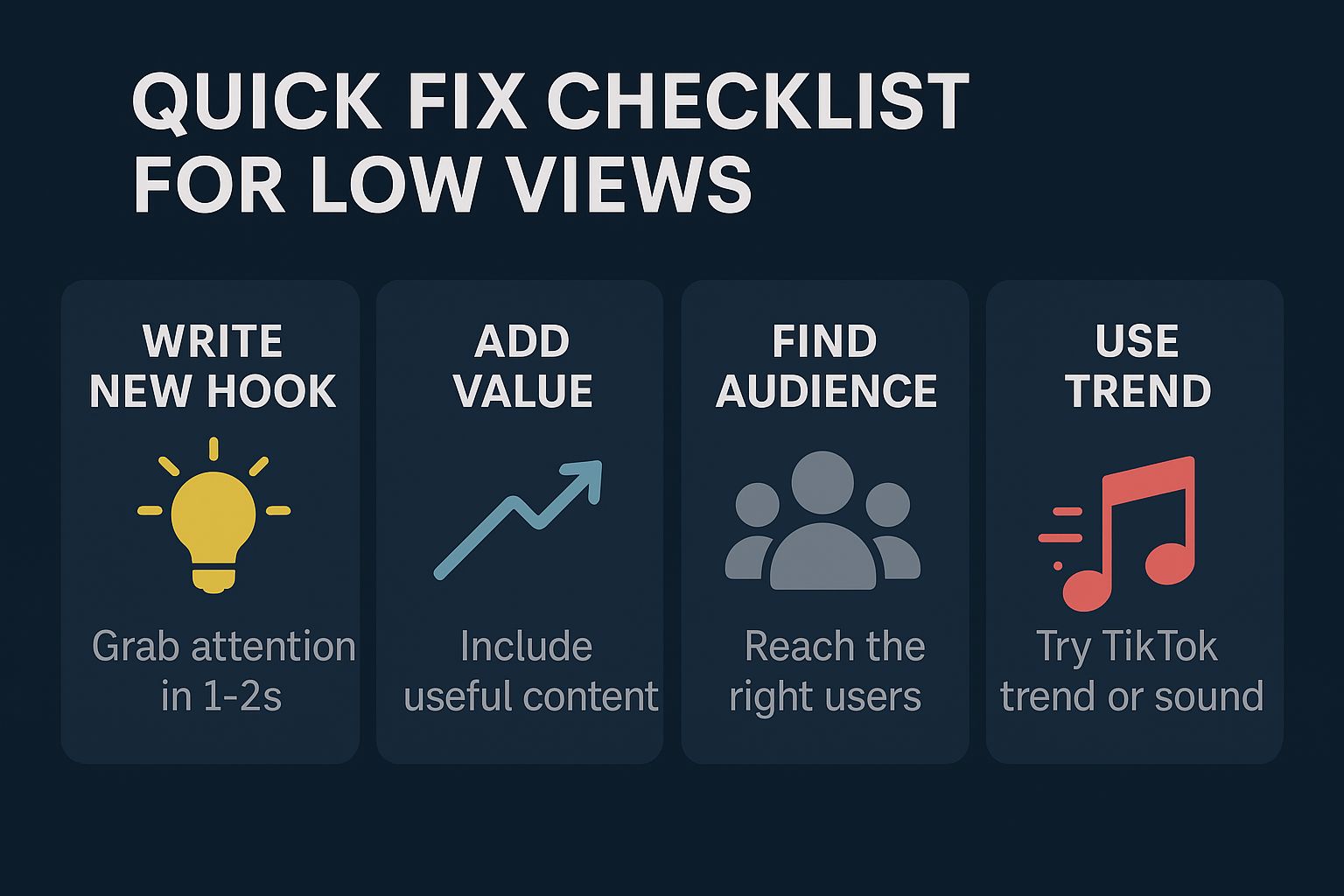
Before you post again, run through this:
| ✅ Checkpoint | Why It Matters |
|---|---|
| First 1 to 2 seconds grab attention | Stops scrolling |
| Trending sound or viral audio | Algorithm push boost |
| Bright colors or strong visuals | Increases watch time |
| Clear niche or category | Helps TikTok route traffic |
| Searchable keywords in text | Boosts discoverability |
| Comment interaction | Signals engagement |
| Consistent posting | Builds retention |
Stuck in 300-view jail? You’re not alone. The creators who break out are the ones who stop guessing, and start adjusting.
Frequently Asked Questions
Is 300 views a lot on TikTok?
On its own it is neither good nor bad. Three hundred views is roughly where a video lands when it completes its first round of distribution without earning a second one. What matters is whether that is where your videos start or where they finish.
How do you get out of 300 view jail?
Each upload gets its own independent test, so this is a per-video problem. Strengthen the first second to hold the opening test audience, and keep posting. If that video promoted a brand or carried an affiliate link, check it has the disclosure TikTok requires.
Why do my views drop right after a video goes viral?
Because a viral post does not raise your account’s baseline. The next video re-enters the same small test audience every post starts in, and it is now being shown to a broad crowd that followed for one clip, so it converts worse than your usual audience would.
Does deleting and reposting the video reset your reach?
There is no evidence for it, and TikTok has never described a reset of that kind. Deleting a video throws away the watch-time signals it had already earned, so a repost starts from zero.
Can TikTok settings cap your views instead of your content?
Yes, distribution settings are a real variable separate from content quality. TikTok’s Branded Content Policy, effective 31 August 2026, requires a commercial content disclosure toggle on gifted, paid and affiliate posts, and TikTok reserves the right to restrict access to promoted content in specific countries.
How long does the post-viral drop last?
TikTok publishes no duration, because it is not a timed penalty. Views recover on whichever upload earns its own second round of distribution, which is why the drop can end on the very next video for one creator and take several for another.

